
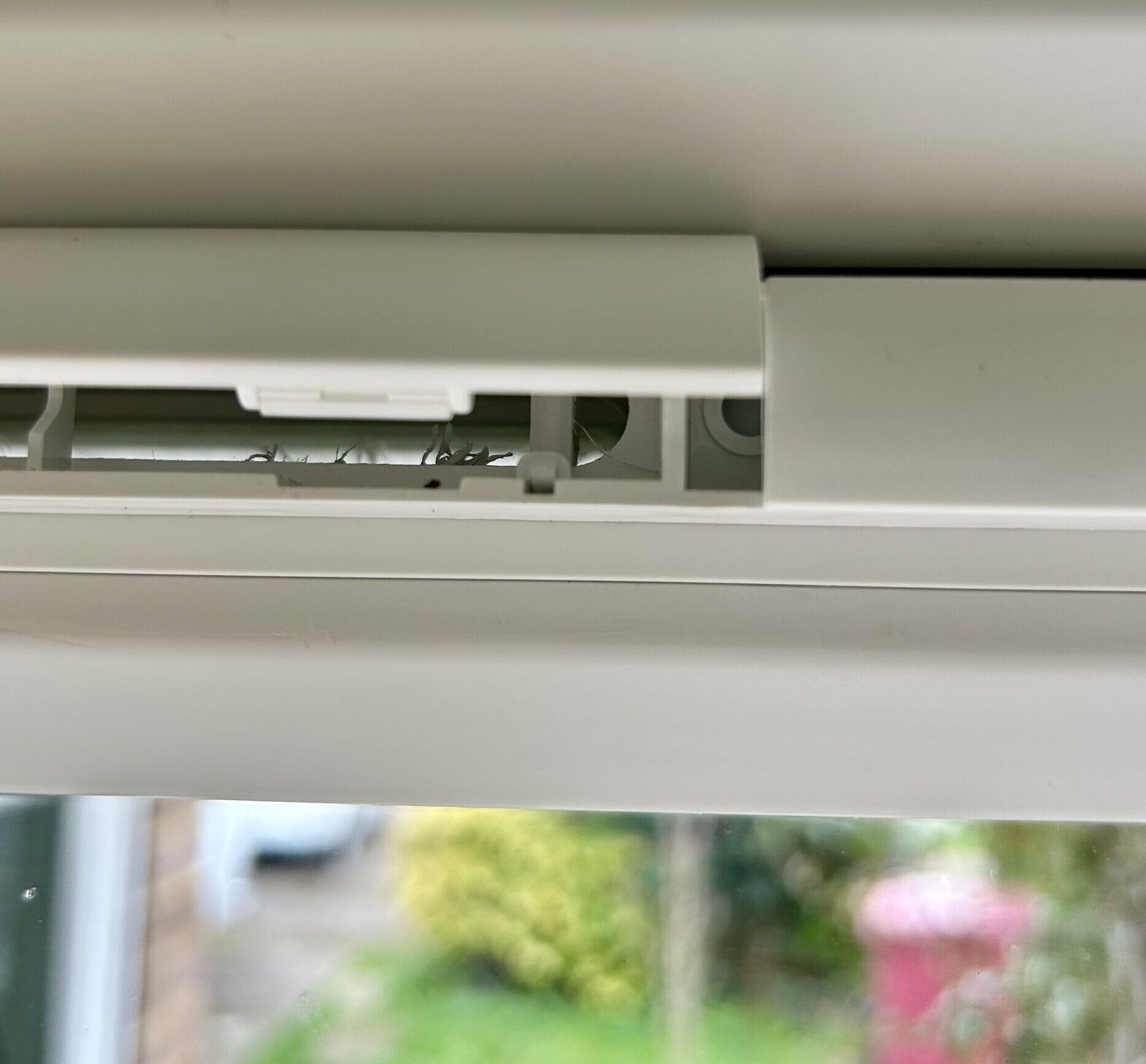
Trickle Ventilators continue to be tricky
During our 2021–22 season, trickle ventilators were already causing us significant concern. By 2026, the problems have only become more widespread and more urgent.
What are trickle ventilators?
Trickle ventilators are small vents, usually fitted into window frames, designed to allow a controlled background flow of fresh air into a room when opened. In practice, however, we’re finding them increasingly unfit for purpose.
The problems we’re seeing with Trickle Ventilators
Across the homes we work in, the same issues appear time and again:
- Draughty even when closed — We found that in a lot of cases, draughts were emanating from the trickle vents even when closed. These vents were surprisingly insubstantial and it was rather a shame to find that they were letting in draughts. It would be possible to seal them to the frames to prevent some of the draughts, but this would be tricky. If the windows can be used in a ventilated position, i.e., fixed in a secure vent position using the second position on the window handle, we recommend sealing the trickle ventilators.
- Missing or decayed insect mesh — On whole estates, particularly those with over-the-head style ventilator arrangements, the insect grilles have become brittle, fallen out, or been knocked out by window cleaners’ brushes. This leaves an unprotected gap in the window frame.
- Vents that won’t close — this is different from draughty when closed, as those do close, but a draught enters between the frame and the vent. Some ventilators have plastic clips that hold the vent in place, and these can break, causing the vent flaps to remain open. Others don’t close properly, allowing draughts even when closed.
- Householders unable to operate them — Trickle vents come in a remarkable variety of designs: some push left or right, some up or down, others click open, and others require a firm but careful press. It’s no surprise that many occupants don’t know how to use them and, in some cases, have never opened them.
The bigger picture
Trickle ventilators are the bane of a DraughtBuster’s life; they are intended to let draughts in, in a controlled way. They are proving themselves to be unfit for purpose. We see ventilation as an active thing, to be controlled by occupants as and when required and a general government directive of ‘one size fits all’ is resulting in draughty homes. We have said before that draughts do too much by way of ventilation when it is windy and not enough when it is calm. Trickle ventilators should now be banned in favour of saving energy. Controlled ventilation is what we need.
The adage, ‘build tight, ventilate right’, is a very good one. Unfortunately, trickle vents, although the intention for them was to help, have turned out to be unhelpful. They cause draughts as highlighted above, do not ventilate properly, and it will take a lot of work to rectify the situation. Sadly, this is a repeat of the same mistake made in the fifties with compulsory through-the-wall vents in all bedrooms in new homes. DraughtBusters expend a lot of effort blocking these, even two generations after they were installed.
What we recommend
Where windows can be held securely in a night-vent or ventilation position using the second handle setting, we recommend sealing trickle ventilators entirely. Controlled, active ventilation, operated by occupants as and when needed, is far more effective than a passive, one-size-fits-all approach. Warm, draught-free homes shouldn’t be a luxury; they’re a matter of health, comfort, and energy efficiency.
If you’ve noticed draughts coming from your window frames and aren’t sure where they’re coming from, then check out some of our further advice online for finding draughts or get in touch with the Reading Borough Council’s Energy Support for potential referral.